

Observability for Pydantic AI with Opik
Pydantic AI is a Python agent framework designed to build production grade applications with Generative AI.
Pydantic AI’s primary advantage is its integration of Pydantic’s type-safe data validation, ensuring structured and reliable responses in AI applications.
Account Setup
Comet provides a hosted version of the Opik platform, simply create an account and grab your API Key.
You can also run the Opik platform locally, see the installation guide for more information.
Getting Started
Installation
To use the Pydantic AI integration with Opik, you will need to have Pydantic AI and logfire installed:
Configuring Pydantic AI
In order to use Pydantic AI, you will need to configure your LLM provider API keys. For this example, we’ll use OpenAI. You can find or create your API keys in these pages:
You can set them as environment variables:
Or set them programmatically:
Configuring OpenTelemetry
You will need to set the following environment variables to make sure the data is logged to Opik:
Opik Cloud
Enterprise deployment
Self-hosted instance
If you are using Opik Cloud, you will need to set the following environment variables:
To log the traces to a specific project, you can add the projectName parameter to the OTEL_EXPORTER_OTLP_HEADERS environment variable:
You can also update the Comet-Workspace parameter to a different value if you would like to log the data
to a different workspace.
Using Opik with Pydantic AI
To track your Pydantic AI agents, you will need to configure logfire as this is the framework used by Pydantic AI to enable tracing.
Practical Example
Now that everything is configured, you can create and run Pydantic AI agents:
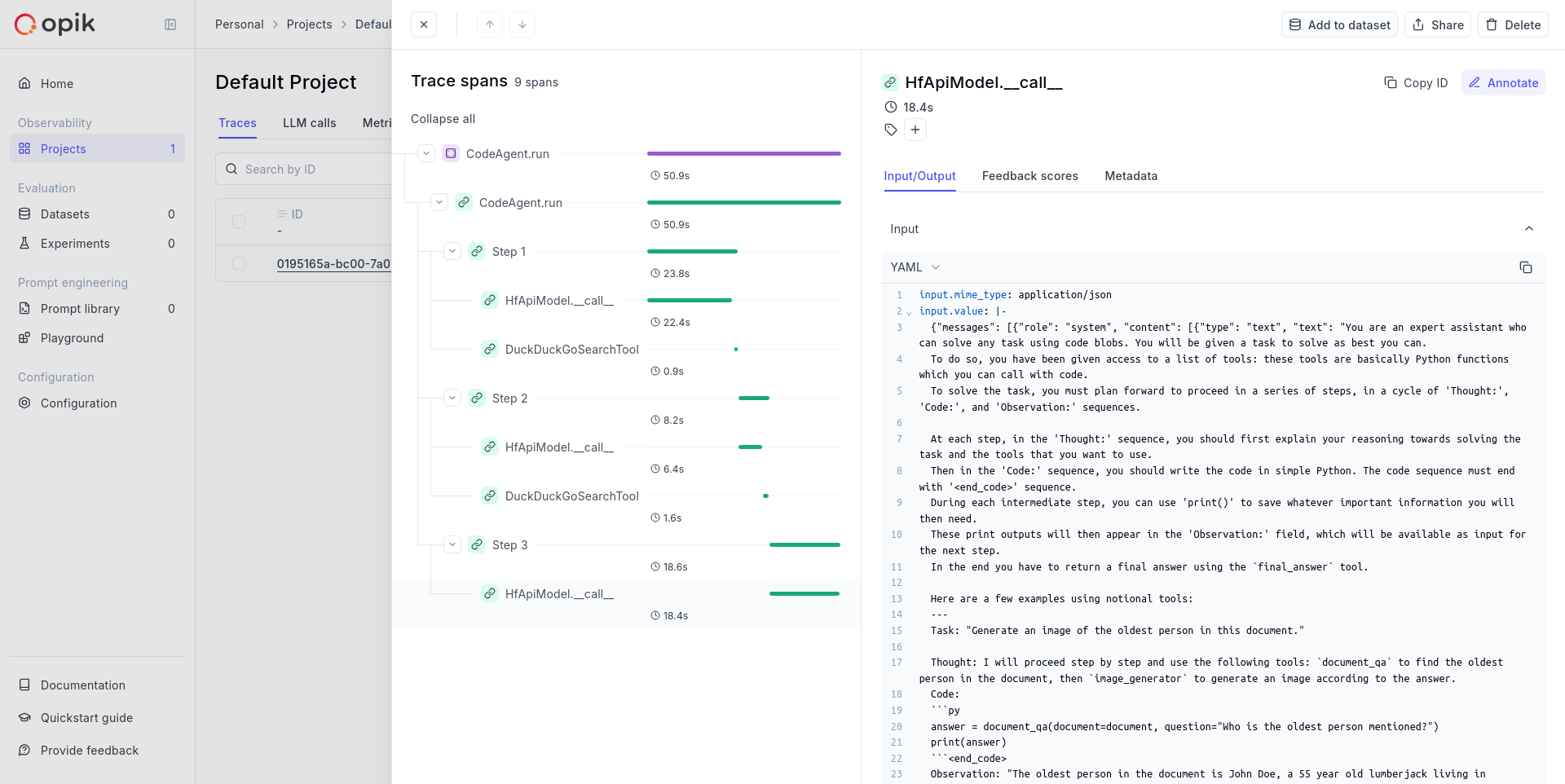
Logging threads
You can group multiple agent calls into a conversation thread by setting thread_id as a span attribute on the root Logfire span. Opik’s OTEL ingestion recognizes this attribute and maps it directly to the trace’s thread_id field:
Combining with @track
If you wrap your agent call in an @track-decorated function — for example to capture a clean entrypoint with its own input/output — the Pydantic AI / logfire spans and the @track span would normally land in two separate traces, since logfire produces OpenTelemetry spans while @track keeps its own context.
Register OpikSpanProcessor on logfire’s tracer provider to merge them into a single trace. The processor links the OpenTelemetry spans to the active @track span automatically — no header propagation or per-call wiring needed:
The result is one trace with the run entrypoint as the root and the agent run / model spans nested underneath. See Linking OpenTelemetry spans to an existing Opik trace for the general mechanism.
Further improvements
If you would like to see us improve this integration, simply open a new feature request on Github.